Tooth Extraction and Socket Preservation: What Happens and Why It Matters

Tooth Extraction and Socket Preservation: What Happens and Why It Matters
Nobody wants to hear that a tooth has to come out. But when a tooth is beyond saving, removing it is often the step that protects everything around it — and what happens in the minutes immediately after the extraction has more to do with your options five years from now than most patients realize.
At our Denver and Westminster periodontal offices, tooth extraction is rarely just a removal. It is the first stage of a plan: preserving the bone, protecting the neighboring teeth, and keeping the door open for an implant if you want one later. Here is what that actually involves.
Why a Tooth May Need to Be Removed
Extraction is a last resort, not a first option. When we recommend it, it is usually for one of these reasons:
- Severe decay. The tooth has lost too much structure to be restored with a filling, crown, or root canal.
- Advanced periodontal disease. The bone that anchors the tooth has been destroyed, and the tooth has lost most of its bony support.
- A fracture that cannot be repaired. Some cracks extend below the gumline or split the root in a way no restoration can address.
- Impaction. The tooth is encased in bone and cannot erupt properly — most commonly wisdom teeth.
- Poor positioning. A tooth sits in a place in the jaw where it causes problems for the teeth around it.
- Orthodontic preparation. Occasionally a tooth is removed to create the room needed for planned tooth movement.
If you are being told a tooth needs to come out and you are not sure why, ask. A good answer should be specific to that tooth — and in some cases a second opinion from a specialist is genuinely worth getting.
What Losing a Tooth Actually Changes
When a tooth that was doing real work is removed, the effects go beyond the gap you can see.
You lose chewing function on that side. Teeth work in pairs. The tooth above or below the one you lost no longer has anything to bite against, so that pair stops contributing to chewing entirely — which is why losing one tooth can feel like losing more than one.
The neighboring teeth move. Teeth are held in position partly by the teeth beside them. Remove one and the others gradually drift and tip into the space. Over time this produces crowding, misalignment, and spots that are difficult to clean — which tends to create new problems of its own.
The opposing tooth can over-erupt. With nothing to meet, a tooth can continue to extrude out of its socket, which can eventually compromise that tooth too.
Your smile changes. This matters more than people expect, particularly when the gap shows during normal expression — laughing, talking, being surprised. Patients often tell us afterward that they had started covering their mouth without consciously deciding to.
The jawbone shrinks. This is the one nobody sees coming, and it is the reason the next section exists.
What an Extraction Actually Feels Like
The honest answer surprises most patients: you will feel a lot of pressure, and you should not feel pain.
That pressure is real and it can be considerable. It comes from the tooth being rocked firmly back and forth, which widens the socket and releases the tooth from the ligament holding it. Local anesthetic blocks pain signals but not pressure sensation, so being thoroughly numb and still feeling significant pushing is completely normal. Patients who have not been told this in advance sometimes interpret the pressure as the anesthetic failing. It is not.
Sometimes the tooth comes out in pieces, on purpose. If the roots are curved or the socket cannot expand enough to release the tooth whole, we section the tooth into pieces and remove each one individually. Occasionally a small amount of bone is removed as well. This is not a complication or a sign that something went wrong — it is a deliberate technique that gets the tooth out with less trauma to the surrounding bone, which matters a great deal if you want an implant later.
Sedation. Many patients do fine with local anesthetic alone. If dental anxiety is a factor for you, bring it up at the consultation so we can plan for it rather than improvising the morning of.
Bone Grafting the Socket, and Why It Is Worth Doing
Healing after an extraction starts with a blood clot forming in the empty socket. That clot is the scaffold everything else builds on, and protecting it is the single most important thing you do in the first few days.
A bone graft placed into the socket helps stabilize that clot and gives the bone a framework to rebuild on. The graft material is packed into the socket and covered with a membrane that holds the particles in place while healing begins.
You may feel some graft particles come loose, and that is expected. Small particles can escape from under the membrane during the first few days — you may notice them on your tongue or against your cheek. That is normal. What is not optional is leaving the site alone: manipulating the surgical area or the sutures too early can cost you the entire graft.
Why This Matters If You Want an Implant
Here is the part worth understanding before you decide. When a tooth is removed and nothing is placed in the socket, the jawbone does not simply stay as it is. The ridge of bone that held the tooth remodels and regresses — it shrinks, both in height and width, and most of that change happens in the first several months.
If you later decide you want an implant, that lost bone has to be rebuilt first. Rebuilding a significantly deficient ridge is a larger surgery, a longer timeline, and a bigger expense than preserving the bone would have been at the time of extraction.
Grafting the socket at the time of removal is what is known as ridge preservation, and it is the reason we bring it up at the extraction appointment rather than later. The decision is easiest to make before the tooth comes out, not after the bone is gone.
Healing Timeline
Days 1 to 3
The most important window. Some bleeding, swelling, and soreness are expected. Bite gently on gauze as directed, use ice, and take pain medication before the numbness fully wears off rather than waiting for discomfort to set in. Protect the clot: no straws, no spitting, no smoking, no poking at the site.
Days 4 to 7
Discomfort drops off noticeably. Most patients are off pain medication and back to normal activity. Gentle rinsing as directed can begin, and you can brush the other teeth normally while leaving the site alone.
Weeks 2 to 4
The gum tissue closes over the site. Sutures dissolve or are removed. The area starts to feel like part of your mouth again rather than a wound.
Months 3 to 4
If a bone graft was placed, this is roughly how long it takes for the graft to turn over — for your own bone to replace the graft material and become solid enough to support an implant.
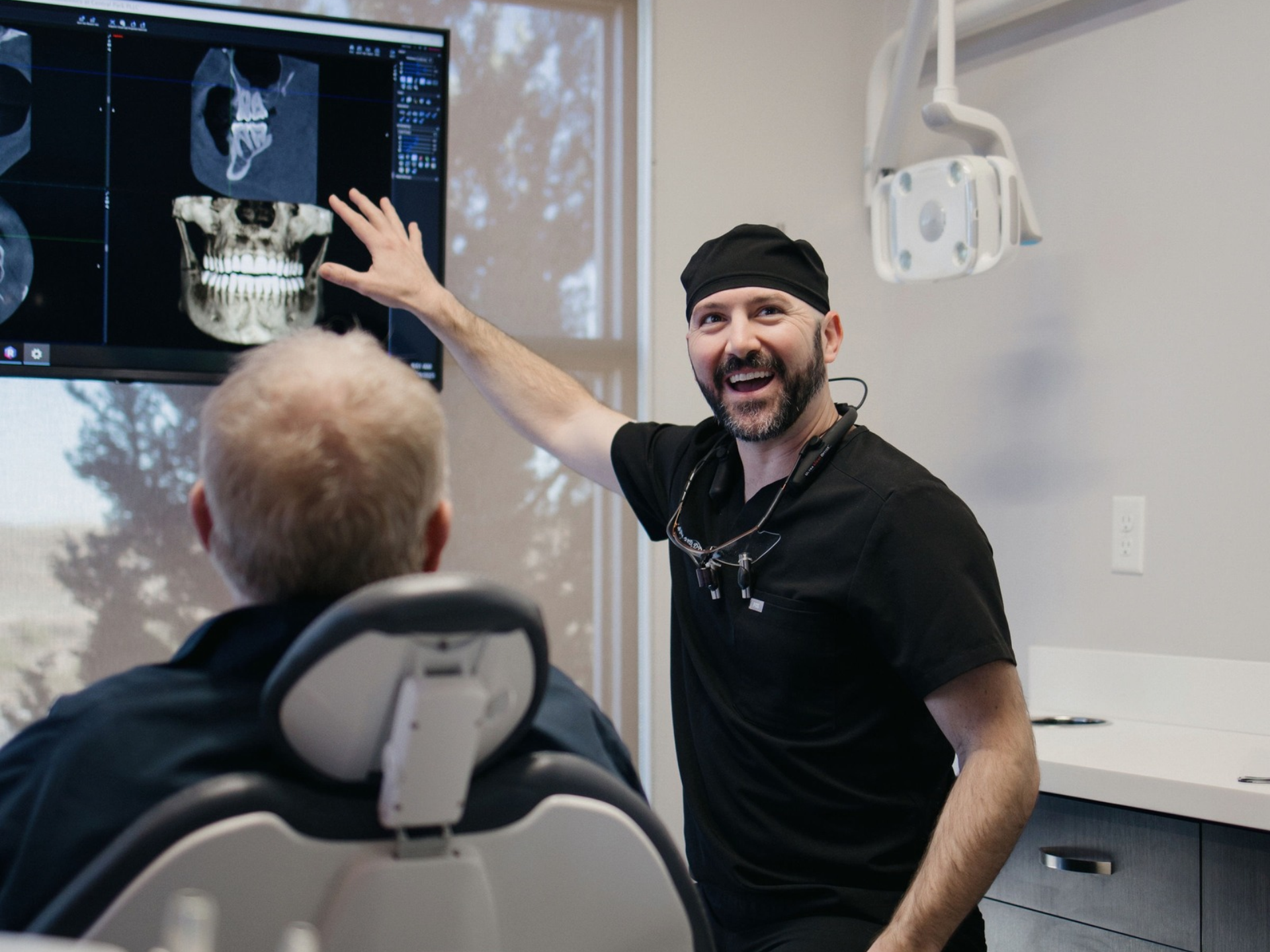
At that point, a CBCT scan — a three-dimensional X-ray — lets us see the bone volume and shape precisely, plan the implant position in advance, and place it accurately. This is what makes implant placement predictable rather than improvised.
Timelines vary. Smoking, diabetes, certain medications, and the size of the original socket all affect how healing goes, which is why your follow-up visits exist.
Protecting the Site While It Heals
Almost every complication we see after an extraction traces back to something on this list.
Avoid for the first several days:
- Straws — the suction can dislodge the clot
- Smoking or vaping, which is the single biggest risk factor for a failed graft and for dry socket
- Spitting forcefully or rinsing vigorously
- Touching the site with your tongue, finger, or anything else
- Lifting your lip to inspect it, which pulls on the sutures
- Hard, crunchy, sharp, or very hot foods
- Strenuous exercise during the first few days
- Alcohol while taking prescribed pain medication
Do:
- Take pain medication before the numbness wears off
- Use ice on and off during the first day for swelling
- Eat soft, cool foods and chew on the other side
- Keep the rest of your mouth clean — brush your other teeth normally
- Rinse gently with salt water once we tell you to start, not before
- Sleep with your head slightly elevated for the first night or two
About Dry Socket
Dry socket happens when the clot is lost before the site has healed, leaving bone exposed. It is painful and it typically announces itself around day three to five with pain that is getting worse rather than better, often radiating toward the ear. It is treatable, and we would much rather see you than have you wait it out.
When to Call Us
Contact the office if you have bleeding that will not slow after sustained pressure, pain that increases after day three, swelling that worsens after day three, a fever, pus or a foul taste, or numbness that does not resolve.
Replacing the Tooth
You do not have to decide this at the extraction appointment, but it is worth knowing the landscape — because grafting the socket keeps all of these options open, and skipping it closes some of them.
Dental implant. A titanium post placed into the bone that supports a crown. It functions like a natural tooth, does not involve the neighboring teeth, and helps preserve the bone around it. It requires adequate bone volume, which is exactly what socket preservation protects. Typically placed three to four months after a grafted extraction.
Fixed bridge. A crown on each neighboring tooth supporting a replacement in between. Faster than an implant and does not require bone volume — but it means reshaping two teeth that may be perfectly healthy, and it does nothing to prevent bone loss underneath.
Removable partial denture. The least expensive option and the least invasive up front. It comes in and out, it takes adjustment to get used to, and it does not stop the bone from resorbing.
Doing nothing. Sometimes reasonable — a wisdom tooth, for instance, usually does not need replacing. But for a tooth in function, the drifting, over-eruption, and bone loss described earlier all continue. If you are choosing this, choose it deliberately rather than by default.
We will walk through which of these genuinely fit your situation, including the honest trade-offs, before you commit to anything.
Next Steps
If a dentist has told you a tooth needs to come out, the most useful thing you can do is understand the whole plan before the appointment — not just the removal, but what goes into the socket and what your options are afterward. Those decisions are far easier to make in advance than to revisit later.
Related Reading
Schedule a Consultation
We see patients at two Denver-area locations — Central Park in Denver and Westpark in Westminster. Call (720) 703-9116 or request an appointment online, and we will walk you through what we see, what your options are, and what each one involves.
Medically reviewed by Kyle Diehl, DDS, PhD, board-certified periodontist. Last updated October 2026.
Connect
with us
wE CAN’T WAIT TO MEET YOU
Call 720.703.9116 or request an appointment online to set up your first visit. We’ll be in touch soon.
